

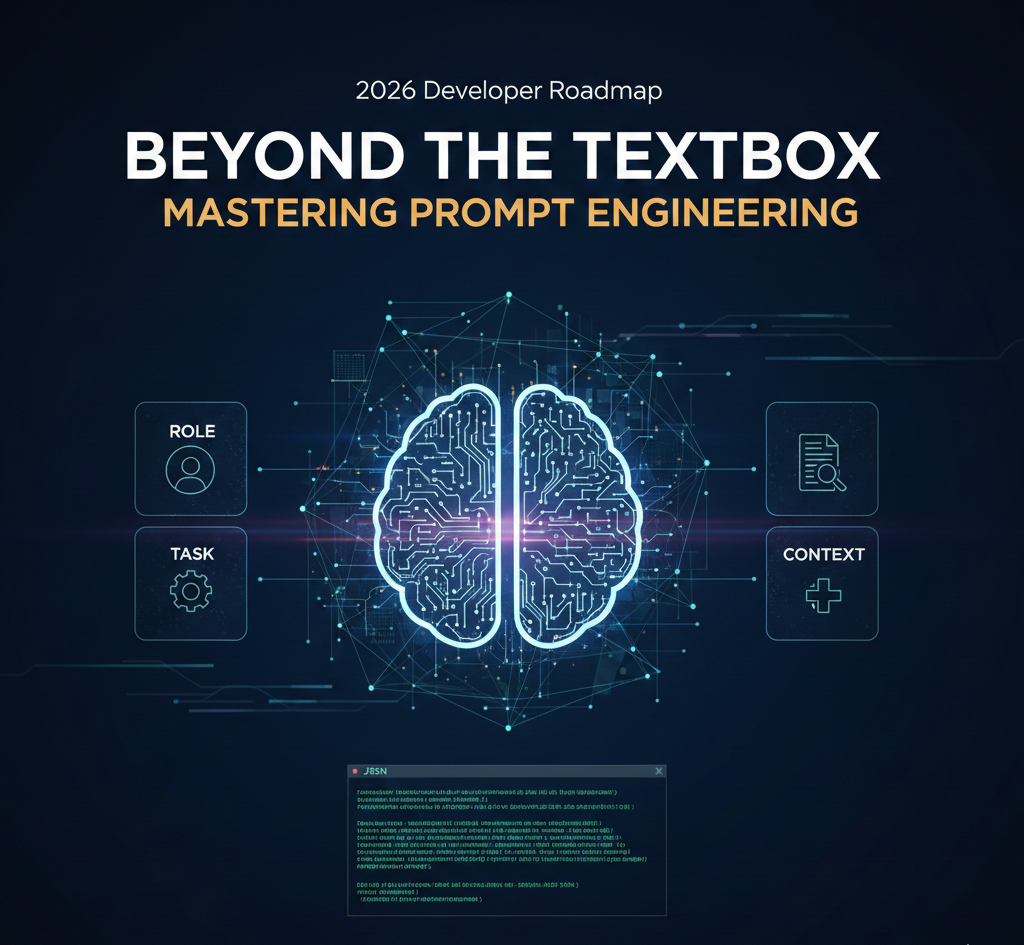
One year on, guess what – chasing good feels with prompts doesn’t cut it anymore. Talking loosely to machines? That era quietly closed its door. Now builders shape how systems respond, not just what they say. Think deeper structure, not charm. New models such as OpenAI’s o3, Claude 4, Gemini 2.5 – they demand precision. The craft changed: words matter less than architecture.
Ready to leave simple chats behind? This 2026 guide walks through real-world prompt engineering – step by step. Instead of small talk, think powerful tools that work where it matters. Each part moves you closer to skilled, reliable results. Not magic, just method. Built for doing, not showing off. Year after year, this path holds up.
1. The 2026 Prompt Framework: Role → Task → Context
The most effective prompts in 2026 follow a modular structure. Stop writing long paragraphs and start using a structured schema.
- Role: Assign a specific persona (e.g., “You are a Senior SRE specialized in Kubernetes security”).
- Task: Define the action with high-precision verbs (e.g., “Refactor,” “Audit,” “Translate to JSON”).
- Context/Constraints: Provide the “rules of the game.”
- Examples (Few-Shot): Show, don’t just tell. Providing 2–3 examples of the desired output format reduces hallucinations by up to 40%.
Pro Tips: By 2026, Reasoning Models – such as those in the o-series – deliver weaker results when users spell out every step of Chain of Thought. These systems work better with minimal prompts, since they rely on built-in reasoning during processing. Their strength lies in independent computation, so extra explanation tends to interfere. Efficiency improves when guidance stays light and avoids micromanaging logic flow.
2. Advanced Techniques for Technical Workflows
Chain-of-Thought (CoT) vs. Tree-of-Thought (ToT)
For complex debugging or architectural planning, a single prompt isn’t enough.
- Chain-of-Thought: Use the phrase “Think step-by-step” for standard models to force logical sequencing.
- Tree-of-Thought: Instruct the model to generate three different architectural approaches, critique each, and then consolidate the best parts into a final recommendation.
Chain of Verification (CoV)
To eliminate “hallucinated” code or facts, use a verification loop:
- Generate: Ask the model for a solution.
- Verify: Ask the model, “Check the above code for deprecated API calls or logic flaws based on the latest documentation.”
- Refine: Have the model output the final, corrected version.
3. From Prompt Engineering to Context Engineering
One big change lately? People get it – good data works harder than clever wording. Lately, coders spend time on RAG and Dynamic Context Injection. Skip baking rules into prompts. Build setups where info flows in smart ways
- Fetch relevant documentation snippets.
- Inject the user’s specific codebase context.
- Provide real-time telemetry data.
| Feature | Static Prompting | Context Engineering (2026) |
| Data Source | Hardcoded in text | Dynamic RAG / Vector DB |
| Reliability | Hit or miss | High (Grounding in facts) |
| Scalability | Manual updates | Automated via API |
4. Prompting for Structured Outputs
In production, you don’t want “chatty” AI; you want data. Use Schema-First Prompting to ensure the LLM acts like an API.
Example Prompt Fragment:
| Markdown |
| Return the analysis strictly in the following JSON format: { “bug_found”: boolean, “severity”: “low” | “medium” | “high”, “fix_suggestion”: “string” } Do not include any preamble or conversational filler. |
The Rise of “Meta-Prompting”
What if the machine writes your instructions instead? By 2026, smart prompting takes center stage. Here’s one path: “Create a prompt that shifts Python 2 scripts into Python 3.12 without losing any test checks. Design a sharp, focused instruction set for a code-focused AI.” Machines tend to catch limits and oddball situations humans skip. That twist could save hours later.
Summary: The Developer’s Checklist
- Identify the Model: Is it a “fast” model (GPT-4o mini) or a “reasoning” model (o3)?
- Modularize: Use the Role-Task-Context-Example structure.
- Automate Evaluation: Use “LLM-as-a-Judge” to score your prompt’s performance across 50 test cases.
- Think Agentic: Don’t ask for the whole solution; ask for the first step and build a chain.