

The AI Revolution Isn’t Coming, It’s Here: Tools Redefining Productivity & Creation
The year 2026 is becoming known as the “Year of Truth for AI.” We’re moving into a new era where Artificial Intelligence isn’t just a freshness, but a primary layer for how we work, create, and innovate. If you’re a professional, a developer, a content creator, or simply someone looking to stay ahead in a rapidly evolving digital landscape, it’s time to combine AI tools into your daily workflow.
Forget incremental gains; the right AI can unlock exponential productivity. Here are four game-changing tools that are currently shaping the cutting edge of tech, and why they deserve a spot in your arsenal.
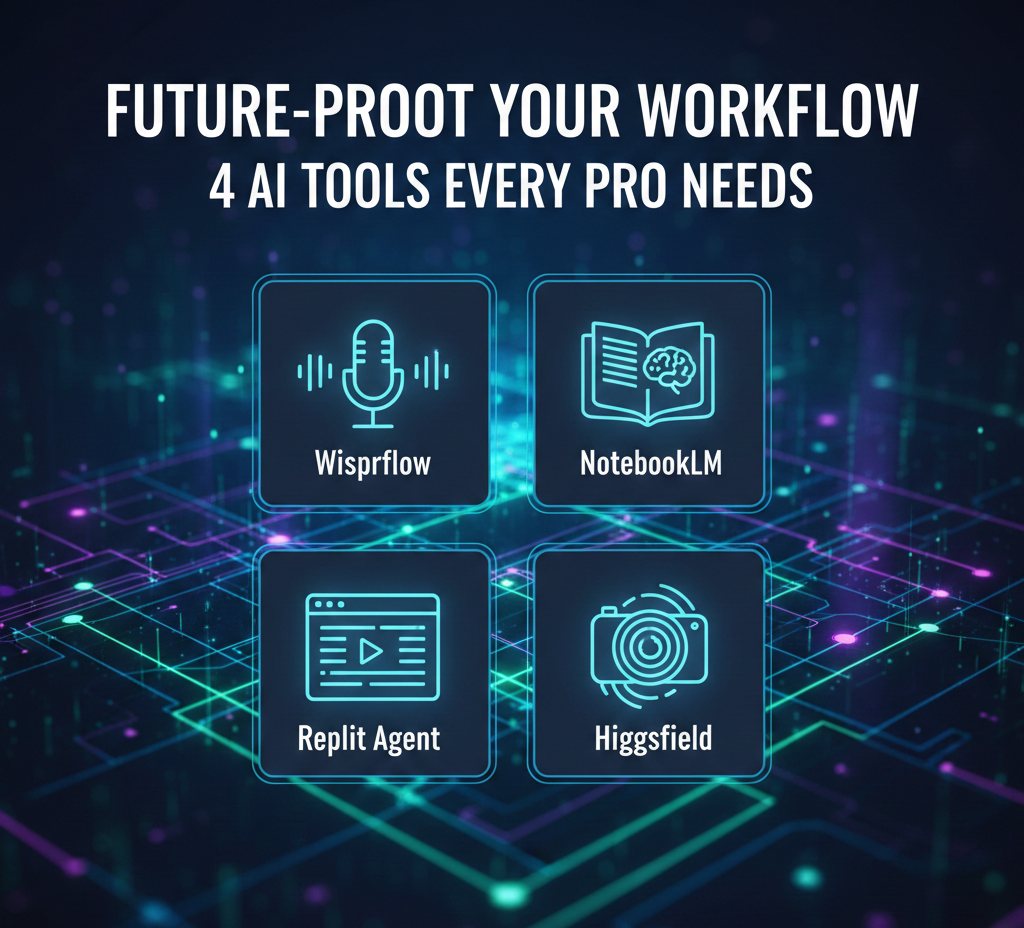
1. Wisprflow: Speak Your Thoughts, Don’t Type Them
Imagine speaking thoughts directly into a document without typing. That is what happens when voice meets intelligent processing through Wisprflow. Instead of simple word capture, it interprets meaning by analyzing surrounding phrases. Most tools hear speech – this one grasps intent. Context shapes output, so results feel less mechanical. Accuracy improves because patterns matter more than isolated sounds. Over time, responses adapt as usage grows. Complexity fades once structure becomes clear. Clarity emerges where confusion used to sit.
Faster thoughts often outpace typing hands. When speech flows freely, shaping it into clear paragraphs becomes valuable. Punctuation appears where needed, guided by context rather than rules. Structure forms behind the scenes, quietly refining raw expression. Meaning shapes word choice; suggestions arise from intent. Creators find their rhythm preserved. Executives recover minutes once lost to formatting. Clarity emerges without effort. Ideas land quickly, close to how they began – in motion.
2. NotebookLM: Your Private AI Research Assistant
Overloaded with data? That defines modern life online. Sifting countless documents – PDFs, journals, studies – drains hours without return. Here enters NotebookLM, operating quietly behind scenes. A tireless helper emerges: one built for understanding complexity while staying always alert.
From whatever you provide – PDFs, online texts, documents, or personal notes – a private workspace forms automatically within NotebookLM. Following ingestion, interaction becomes possible through inquiry, allowing detailed responses drawn solely from your material. Summarization of lengthy content occurs efficiently, extracting core ideas without oversimplifying. Instead of static storage, the system enables dynamic exploration, turning scattered inputs into structured understanding. When handling research, reporting, or academic work, access to synthesized insights replaces manual sorting. Podcast-like narratives emerge from combined entries, offering an alternative way to absorb context. Knowledge remains contained, processed only from what was originally supplied by the user. Complex queries receive focused answers rooted directly in uploaded sources. This approach supports clarity when navigating dense collections of information. The function serves those managing extensive written records without altering their original intent.
3. Replit Agent: Build Apps by Expressing Your Intent
A transformation shapes how developers approach code. At its core stands Replit Agent, guiding movement toward intent-based creation. Writing each detail by hand fades into the past when building basic functions. Instead, one states purpose, behavior, and expected result using everyday words.
Building a team task manager featuring a Kanban interface along with login controls? That idea becomes the starting point. Within minutes, Replit Agent initiates construction across frontend, backend, database layers. Setup routines form automatically while structural guidance appears alongside progress. Attention shifts toward distinct features instead of repetitive steps. Development timelines shorten noticeably under this approach. Creation opens up beyond traditional boundaries gradually. This process involves collaboration – guided by insight rather than simple automation alone.
4. Higgsfield: Your AI-Powered Video Production Studio
Picture-based communication dominates by 2026. Strong videos are now essential, not optional. Yet producing sharp visuals once demanded large budgets, long timelines. With artificial intelligence, Higgsfield changes who gets access to premium tools. The system goes beyond editing – functioning more like a smart film environment. Control usually reserved for lead creatives becomes reachable through guided automation.
From a simple idea or written outline, Higgsfield produces striking imagery through artificial intelligence. Camera positioning shifts intelligently, guided by scene demands rather than manual input. Lighting adapts dynamically, responding to mood and context within each frame. Cinematic supplementary footage emerges seamlessly, aligned precisely with storytelling intent. Marketers may find value here, just as social media coordinators do – also solo creators pursuing professional-grade results. High-end production quality becomes reachable, minus the massive financial outlay. Vision translates smoothly into finished output, enabled by rapid, intuitive processing. What once took days now unfolds swiftly, though not at the cost of detail. Ease enters the workflow naturally, built into every stage of creation.
Embrace the Future, Today
Future work does not remove people because of artificial intelligence; instead, human ability grows alongside it. Applications such as Wisprflow appear not simply to improve routine tasks – entirely different paths open through their presence. When systems like NotebookLM join daily processes, advancement is shaped quietly, without fanfare. Replit Agent enters the scene, shifting how outcomes form across projects. With Higgsfield in motion, results emerge differently than before. Progress takes place where tools meet intention. Innovation hides within adjustments few notice at first glance.